Remediation strategy depends entirely on structural design and infestation density across Ward County homes. Thermal remediation uses industrial heaters and axial air movers to circulate dry heat through insulated wall…
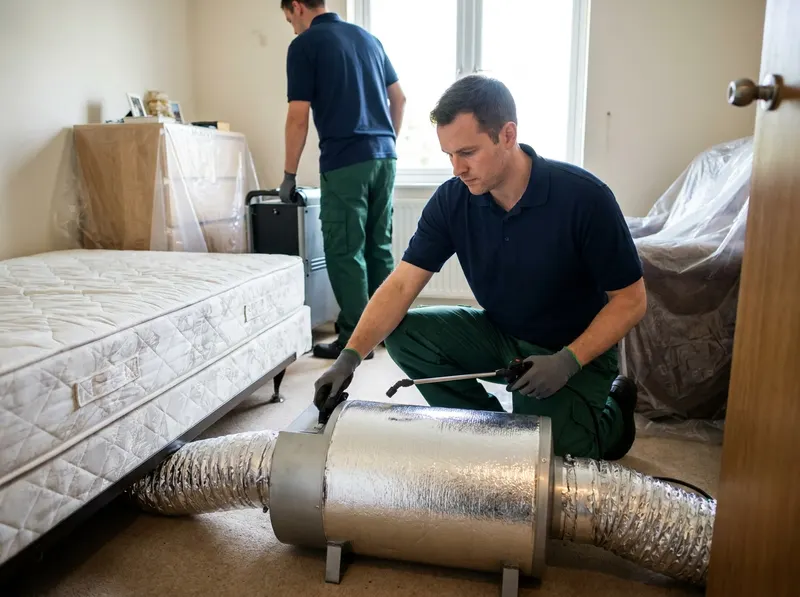
Remediation strategy depends entirely on structural design and infestation density across Ward County homes. Thermal remediation uses industrial heaters and axial air movers to circulate dry heat through insulated wall assemblies, floor joists, and mattress seams until core harborages reach 122°F, the lethal threshold for bed bug nymphs and eggs. In single-family ranch homes in Bel Air, Perkett, and Green Acres, full thermal baking eradicates populations hiding deep inside insulated exterior walls in a single mobilization. In contrast, older two-story builds in Eastwood Park or properties along the Souris River Basin near Oak Park often require a hybrid plan: whole-zone heat combined with non-repellent residual chemicals placed along perimeter baseboards, under subflooring, and inside switch plates to intercept any stray insects attempting to escape toward cooler outer wall cavities.
Decision guidance dictates thermal remediation for immediate, comprehensive clearance of multi-room harborages or clutter-dense rental units near Minot State University and the North Dakota State Fairgrounds. Chemical remediation alone serves localized, early-detection scenarios or budget-constrained single rooms, requiring two to three follow-up visits spaced 14 days apart to break the egg hatch cycle. The operational trade-off centers on prep labor versus time: thermal treatment requires clearing heat-sensitive items, including vinyl blinds, aerosol cans, wax candles, and electronics, but finishes in one working day, whereas chemical-only plans minimize thermal prep but demand strict multi-week monitoring and repeated disruption.
Winter conditions in Minot introduce specific thermodynamic challenges that national checklists overlook. Below-zero ambient temperatures on North Hill and South Hill cause significant thermal transfer through uninsulated rim joists and concrete foundations. Structural heat protocols in these zones require supplemental BTU output and interior thermal sensors placed directly at baseboard-floor intersections to prevent cold spots where bed bugs could survive. Rural properties in the Nedrose area and developments in Terracina with walkout basements receive focused infrared verification along foundation perimeters to ensure uniform heat penetration before cooling cycles begin.
Every job gets a firm, written price after a free on-site visit.
Tell us about your bed bug thermal & chemical remediation job in Minot and we'll send a clear, written quote, usually the same day.
 Nexvora Pest Control